

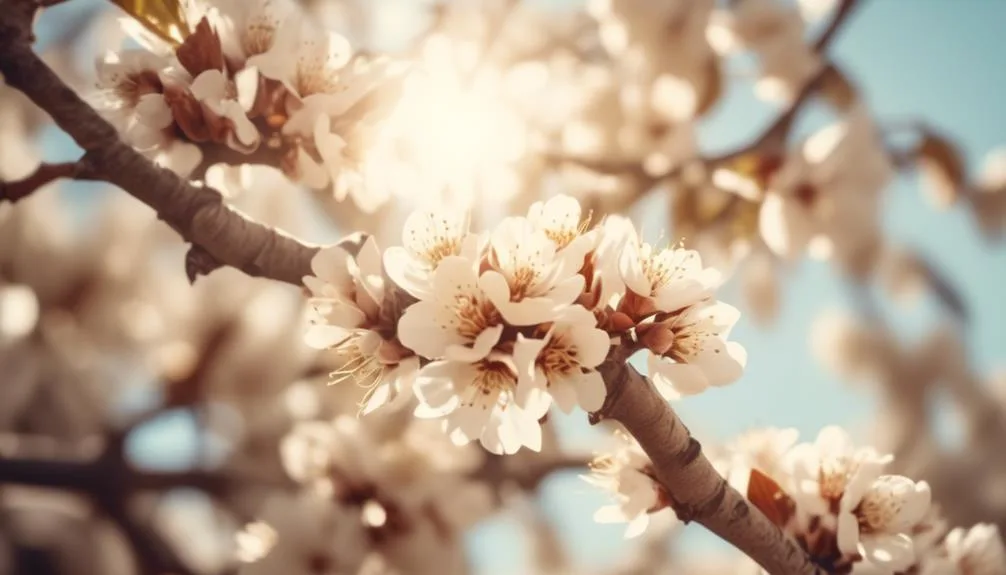
Ever wonder why almond trees need full sun to thrive? It's not just a coincidence. The amount of sunlight directly affects their ability to grow, produce nutrients, and stay healthy.
But there's more to it. Full sun is also crucial for a successful almond yield. So, why is sunlight so important for almond trees? Let's find out.
Key Takeaways
- Full sun exposure is crucial for maximizing energy production through photosynthesis and promoting growth and development in almond trees.
- Adequate sunlight stimulates nutrient production, leading to better absorption of essential elements and robust root development.
- Ample sunlight helps prevent diseases and improves overall tree health by enhancing natural defense mechanisms and reducing fungal growth.
- Full sun exposure plays a vital role in flowering, pollination, and fruit set, resulting in increased almond yields.
Optimal Photosynthesis
To achieve optimal photosynthesis in almond trees, ensure they receive full sun throughout the day to maximize their energy production. Leaf orientation plays a crucial role in this process. Almond tree leaves are typically arranged in a way that maximizes sunlight penetration. Their flat, broad surfaces are strategically positioned to capture the most sunlight possible.
When almond trees are in full sun, the leaves can efficiently absorb and convert sunlight into energy through photosynthesis. This process is essential for the tree's growth, development, and ultimately, almond production. Without adequate sunlight, the photosynthetic efficiency of the tree decreases, impacting its overall health and productivity.
Therefore, ensuring that almond trees receive full sun exposure enables them to optimize their photosynthetic capabilities, leading to healthier and more productive trees.
Recommended Products

Remy Human Hair: The tape-in extensions are made from real human hair with preserved cuticles to support a natural appearance and texture; all hair extensions are real human hair, with inspection reports available

Remy Human Hair: The tape-in extensions are made from real human hair with preserved cuticles to support a natural appearance and texture; all hair extensions are real human hair, with inspection reports available

MATERIAL- Top excellent quality colorful optical K9 crystal glass, no coating colors, no plastic or acrylic, super sparkling, will never fade
Nutrient Production
Maximizing almond trees' exposure to full sun not only boosts their photosynthetic efficiency but also contributes significantly to their nutrient production. Here's why:
- Nutrient Absorption: Full sun exposure stimulates the production of essential nutrients within the almond trees, enabling them to absorb vital elements such as nitrogen, phosphorus, and potassium more effectively.
- Enhanced Root Development: The ample sunlight encourages robust root development, allowing the trees to establish a strong and extensive root system. This, in turn, facilitates better nutrient uptake from the soil.
- Increased Nutrient Synthesis: Sunlight triggers biochemical processes within the trees, leading to the synthesis of key nutrients like carbohydrates, proteins, and fats, which are crucial for their growth and overall health.
- Improved Nutrient Transport: Full sun exposure promotes the efficient transport of nutrients within the almond trees, supporting their essential physiological functions and overall productivity.
Disease Prevention
Ensuring almond trees receive ample sunlight is crucial for preventing diseases and promoting their overall health and productivity. Sun exposure helps in disease prevention by creating an environment that is less favorable for pathogens to thrive. Additionally, it enhances the tree's natural defense mechanisms, improving pest resistance. Here's a visual representation of how sun exposure contributes to disease prevention and pest resistance:
| Sun Exposure Benefits | Effects on Almond Trees |
|---|---|
| Increased Photosynthesis | Stronger immune system |
| Drier Canopy | Reduced fungal growth |
| Enhanced Nutrient Absorption | Improved overall health |
Flowering and Pollination
Ample sunlight not only aids in disease prevention but also plays a crucial role in the flowering and pollination of almond trees. Here's why:
- Pollinator Attraction: Full sun exposure increases the visibility and attractiveness of almond tree flowers to pollinators, such as bees and butterflies, ensuring successful pollination.
- Bloom Synchronization: Sunlight helps in synchronizing the blooming period of almond trees, ensuring that flowers are ready for pollination at the same time, which is essential for efficient cross-pollination.
- Optimal Flower Development: Sunlight provides the energy needed for the development of healthy, robust flowers, which are more likely to attract pollinators and successfully set fruit.
- Fruit Production: Adequate sunlight directly impacts the pollination process, leading to increased fruit set and ultimately higher almond yields.
Improved Yield
To enhance almond tree yield, ensuring optimal sunlight exposure is crucial for promoting efficient pollination and fruit production. Adequate sunlight is essential for increased productivity in almond trees. When almond trees receive full sun, they're more likely to produce a higher yield of healthy nuts. Sunlight requirements are particularly important during the critical stages of flowering, pollination, and nut development.
Insufficient sunlight can lead to reduced fruit set and lower overall yield. Additionally, full sun exposure helps in the efficient utilization of nutrients, leading to better fruit quality and quantity. By meeting the sunlight requirements of almond trees, you can significantly improve their yield and overall productivity.
Recommended Products

Made for Banana Trees – Specially formulated banana fertilizer designed to support the nutrient needs of banana plants.

Package contains 9 tree and shrub fertilizer spikes and are produced to avoid wasteful runoff, mess, hazards and smells

Supports Strong Roots & Leaf Development – Helps encourage sturdy root systems and vibrant seasonal foliage.
Conclusion
In providing almond trees with ample sunlight, you're enabling them to thrive and yield an abundant harvest. The benefits of full sun—enhanced photosynthesis, nutrient production, disease prevention, and successful flowering—are essential for their overall well-being.
Consider the impact of sunlight on almond trees and how it can ultimately contribute to a bountiful outcome.
